PROJECT 01 / AI Application · Document Automation · Full-Stack Prototype
TenderCare: AI-Assisted Tender Response
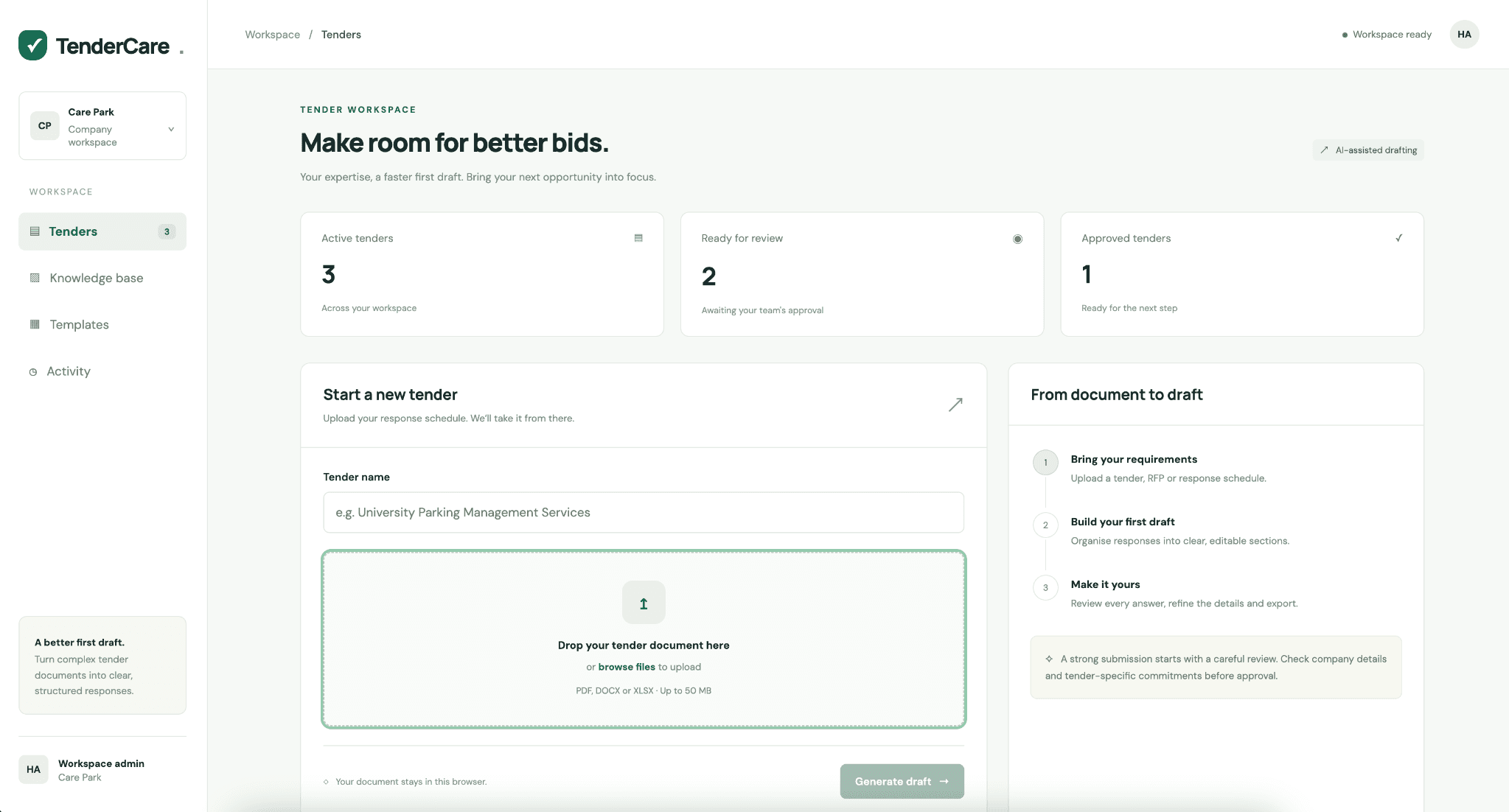
A full-stack prototype that turns tender documents into structured draft responses, gives users a review and editing workspace, and generates formatted response files for downstream submission.
01 / CONTEXT
The problem
Tender and RFP responses often require teams to work through long documents, identify individual requirements, draft answers, confirm company information, and place approved responses back into a required submission format. TenderCare explored how AI and workflow automation could reduce that manual effort while keeping a human reviewer in control of the final response.
02 / APPROACH
The system
I developed and tested a prototype combining a web application, document-processing logic, AI-assisted drafting, and workflow orchestration. Users upload tender or response-schedule documents, which the application backend parses into structured requirements. AI generates draft answers organized by tender section. Users review, edit, and approve responses before generating formatted Excel response files. Downstream n8n workflows connect business systems and package generated outputs for delivery back to the application.
03 / ARCHITECTURE
How the pieces connect.
- 01Application
Next.js, React, and TypeScript provide uploads, the tender workspace, review, editing, approvals, and status tracking.
- 02Document processing
Firebase and Google Cloud Functions handle uploaded documents, parse source structure, and prepare structured requirements for AI processing.
- 03AI-assisted drafting
Genkit and language models interpret requirements, draft structured answers, and surface information requiring human verification.
- 04Human review
Users review and edit answers, confirm company-specific information, and approve final responses.
- 05Integration & outputs
n8n orchestrates business-system lookups, output generation, Google Drive delivery, and packaging back to the dashboard.
Architecture overview based on the supplied implementation details.
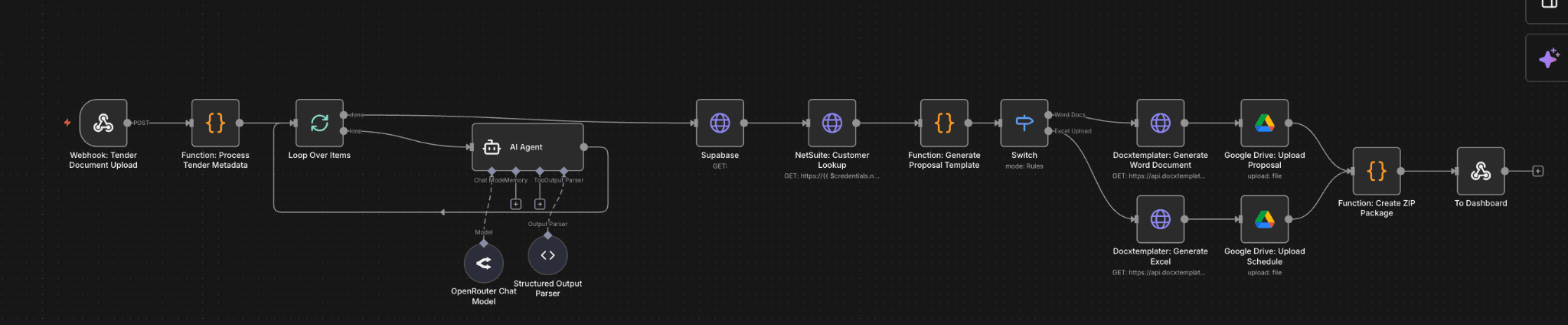
DOWNSTREAM ORCHESTRATION / n8n
From prepared metadata to packaged outputs.
Document parsing happens in Firebase and Google Cloud Functions. This downstream workflow processes tender metadata, connects business systems, routes Word and Excel outputs, and returns packaged files to the dashboard.
04 / ENGINEERING FOCUS
Technical challenges
- Preserving document structure: extract requirements from nonuniform documents while retaining the links between questions, answers, and output locations.
- Mapping responses back into Excel: place generated answers in the correct cells and sections of response schedules rather than producing unstructured text.
- Controlled AI generation: distinguish content that can be drafted confidently from information requiring human confirmation.
- Data consistency across layers: keep structured data consistent across parsing, the application interface, AI workflows, automation services, and generated outputs.
- Multi-system integration: coordinate application code, Firebase services, AI models, n8n, business-system lookups, document-generation APIs, and Google Drive.
05 / OUTCOMES
Results & evidence
The prototype demonstrated an end-to-end workflow for turning tender documents into structured, editable draft responses and generating reusable response files for human review. It validated how application-level document processing, AI-assisted drafting, and workflow automation could work together within a tender-response process.
My contribution
I developed and tested the prototype, built the review interface, connected the document-processing and AI components, integrated workflow automation, and iterated on generated tender outputs.
06 / GALLERY